Currently at dekinai we use a Raspberry Pi 4, but its limited power has led us to consider an upgrade. With that in mind, this article compares the specs of boards worth buying in 2026.
As of 2026, the single-board computer (SBC) market is more diverse than ever. High-performance boards such as the Raspberry Pi 5, Radxa ROCK 5B+, Orange Pi 5 Plus, and NVIDIA Jetson Orin Nano Super have appeared one after another, making it necessary to choose the best option depending on the use case.
We thoroughly compared these four major SBCs across three axes: specs, benchmarks, and price. From edge AI development to general-purpose Linux desktops and hobby projects, here is a detailed analysis based on real measured data to help you pick the board that best fits your needs.
What You'll Learn in This Article
- Measured data comparing the CPU, GPU, and NPU performance of the four boards using Geekbench 6 and AI TOPS
- Practical benchmarks for LLM inference speed (tok/s) and NVMe storage performance
- The truth about cost performance seen through the price-to-performance ratio (Score/dollar)
- A board selection guide by use case (edge AI, Linux desktop, hobby)
- Current 2026 pricing, availability, and purchasing considerations
Basic Spec Comparison of the Four Boards
Spec Comparison Table (in order of performance: left → right, low → high)
| Item | Raspberry Pi 5 | Orange Pi 5 Plus | Radxa ROCK 5B+ | Jetson Orin Nano Super |
|---|---|---|---|---|
| SoC | Broadcom BCM2712 | Rockchip RK3588 | Rockchip RK3588 | NVIDIA Orin Nano (Super) |
| CPU | 4× A76 @ 2.4GHz | 4× A76 @ 2.4GHz + 4× A55 @ 1.8GHz | 4× A76 @ 2.4GHz + 4× A55 @ 1.8GHz | 6× A78AE @ 1.7GHz |
| GPU | VideoCore VII 800MHz | Mali-G610 MP4 | Mali-G610 MP4 | 1024-core Ampere + 32 Tensor cores |
| NPU / AI | None (CPU only) | 6 TOPS (Rockchip NPU 3.0) | 6 TOPS (Rockchip NPU 3.0) | 67 INT8 TOPS (Sparse) / 33 TOPS (Dense) |
| Memory | 2/4/8/16GB LPDDR4X | 8/16/32GB LPDDR4X/LPDDR5 | 8/16/32GB LPDDR5 | 8GB LPDDR5 (102 GB/s) |
| Storage | PCIe 2.0 x1 (HAT) + microSD | M.2 NVMe (E/M key) + eMMC + microSD | M.2 2280 NVMe (PCIe 3.0 x4) + eMMC + microSD | M.2 NVMe (external) + SD card |
| Network | 1GbE + Wi-Fi 5 + BT 5.0 | Dual 2.5GbE | Dual 2.5GbE | 1GbE |
| Video Output | Dual 4Kp60 Micro HDMI | Dual HDMI 2.1 + HDMI input | Dual HDMI 2.1 (8K@60 + 4K@60) | DisplayPort + HDMI |
| Power Consumption | 2.4W (idle) / 7.1W (max) | approx. 5-10W range | 3.2W (idle) / 9.4W (max) | 7W / 15W / 25W (MAXN Super) |
| Price (approx.) | $60-80 (4-8GB) / $199 (kit) | $100-135 (8GB) | $130-160 (16GB) | $249 (DevKit) |
| Primary Use | Education, hobby, general-purpose Linux, IoT | General-purpose SBC, media, vision builds | General-purpose Linux desktop, vision experiments, storage aggregation | Robotics, edge AI, LLM inference |
Characteristics of Each Board
Raspberry Pi 5: The Most Mature Ecosystem
The Raspberry Pi 5 is equipped with Broadcom's BCM2712 SoC (a 4-core Cortex-A76 @ 2.4GHz) and a VideoCore VII GPU. CPU and GPU performance improved 2-3x over the previous-generation Pi 4, and the newly developed "RP1" I/O controller enables NVMe booting via PCIe 2.0 x1.
Its greatest strength is the mature software ecosystem centered on Raspberry Pi OS, along with the abundant libraries and tutorials from communities worldwide. It remains the safest choice for education, hobby projects, and general-purpose Linux use.
Orange Pi 5 Plus: The King of Cost Performance
The Orange Pi 5 Plus is equipped with a Rockchip RK3588 SoC (an 8-core configuration of 4×A76 + 4×A55), a Mali-G610 MP4 GPU, and a 6 TOPS NPU. Despite featuring dual 2.5GbE, M.2 NVMe, and HDMI input, the 8GB model is priced affordably at $100-135.
It combines 70-80% higher CPU performance than the Pi 5 with 6 TOPS of AI acceleration, offering an excellent balance for media processing, vision builds, and general-purpose SBC use.
Radxa ROCK 5B+: Top-Tier General-Purpose Performance
The Radxa ROCK 5B+ also uses the same RK3588 SoC as the Orange Pi 5 Plus, but differs in offering up to 32GB of LPDDR5 memory and PCIe 3.0 x4 NVMe (1,820-2,100 MB/s). It comes fully equipped with dual 2.5GbE and dual HDMI 2.1 (8K@60 + 4K@60), and also stands out for having the most robust official support from Armbian.
At $130-160 for the 16GB model, it offers excellent performance for the price, making it an ideal choice for vision experiments, storage aggregation, and Linux desktop use.
Jetson Orin Nano Super: The Definitive Edge AI Board
The Jetson Orin Nano Super is equipped with a 6-core Cortex-A78AE CPU and a 1024-core Ampere GPU (32 Tensor cores), delivering up to 67 TOPS (INT8 Sparse) of AI performance. With 8GB of LPDDR5 (102 GB/s), it can seamlessly run vision transformers, large language models (LLMs), and vision-language models.
For LLM inference, it achieves 21.75 tok/s on Qwen2.5-7B and approximately 31 tok/s on DeepSeek-R1-Distill-Qwen-1.5B, recording 3-4x the speed of the Raspberry Pi 5 (5.80 tok/s on Llama 3.2 3B). It offers overwhelming performance for robotics, edge AI, and LLM inference, though the $249 DevKit price is a drawback.
Benchmark Comparison
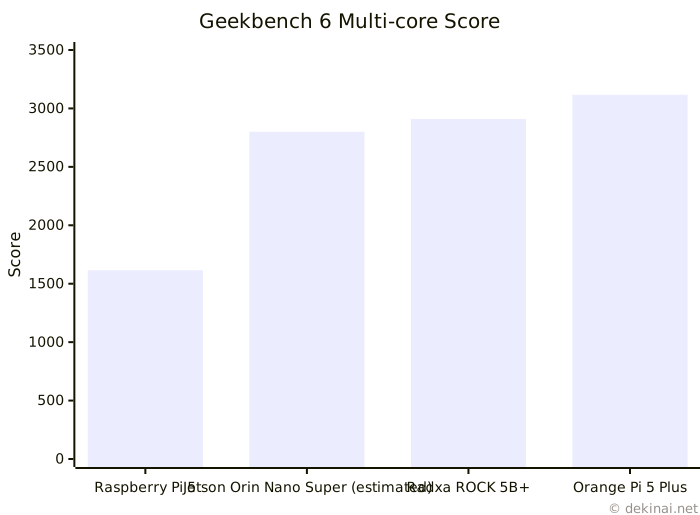
CPU Performance: Geekbench 6
| Board | Single-core | Multi-core |
|---|---|---|
| Raspberry Pi 5 | ~742 | ~1,517-1,615 |
| Jetson Orin Nano Super | Not disclosed (A78AE advantage) | Not disclosed (6-core A78AE) |
| Radxa ROCK 5B+ | ~775-820 | ~2,910-3,043 |
| Orange Pi 5 Plus | ~775-820 | ~2,750-3,117 |
The RK3588-based ROCK 5B+ and Orange Pi 5 Plus record 80% higher multi-core performance than the Pi 5. Their 8-core configuration (4×A76 + 4×A55) proves effective for multi-threaded workloads.
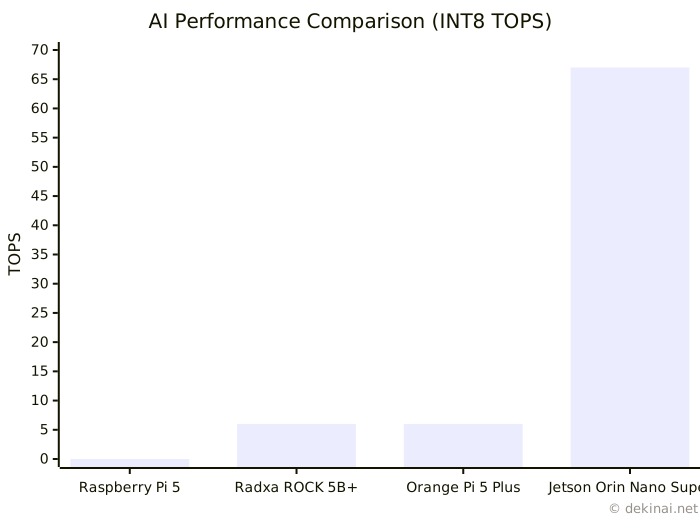
AI Performance: INT8 TOPS
| Board | NPU / GPU | INT8 TOPS |
|---|---|---|
| Raspberry Pi 5 | None | 0 (CPU only) |
| Radxa ROCK 5B+ | Rockchip NPU 3.0 | 6 TOPS |
| Orange Pi 5 Plus | Rockchip NPU 3.0 | 6 TOPS |
| Jetson Orin Nano Super | Ampere GPU + Tensor cores | 67 TOPS (Sparse) / 33 TOPS (Dense) |
The Jetson Orin Nano Super's 67 TOPS is 11x higher than the 6 TOPS of the ROCK 5B+ or Orange Pi 5 Plus. Note, however, that the Rockchip NPU requires Rockchip's own toolchain and is not CUDA-compatible.
LLM Inference Performance: tok/s
| Model (Quantization) | Raspberry Pi 5 | Jetson Orin Nano Super |
|---|---|---|
| Qwen2.5-7B (INT4) | - | 21.75 tok/s |
| Llama 3.2 3B (Q4_K_M) | 5.80 tok/s | - |
| DeepSeek-R1-Distill-Qwen-1.5B (Q4) | - | ~31 tok/s |
The Jetson Orin Nano Super achieves inference speeds exceeding 20 tok/s even on 7B-class LLMs, a level sufficient for real-time conversation. The Pi 5, meanwhile, manages only 5.80 tok/s even on a lightweight 3B-class model — a speed that is challenging for practical use.
Storage Performance: NVMe Sequential Read
| Board | Read Speed |
|---|---|
| Raspberry Pi 5 | Approx. 880 MB/s (via PCIe HAT) |
| Orange Pi 5 Plus | Approx. 1,500-1,800 MB/s (depending on M.2 implementation) |
| Radxa ROCK 5B+ | 1,820-2,100 MB/s |
| Jetson Orin Nano Super | Depends on external NVMe (equivalent to PCIe 3.0 x4) |
The ROCK 5B+'s PCIe 3.0 x4 NVMe is more than twice as fast as the Pi 5's PCIe 2.0 x1. This creates a significant difference in large-file read/write operations and database processing.
Real Workload Comparison: Pi 5 vs ROCK 5B+
| Workload | Pi 5 (8GB) | Rock 5B+ (16GB) | Difference |
|---|---|---|---|
| 7-zip compression (MIPS) | 16,500 | 28,400 | +72% |
| Geekbench 6 Multi-core | 1,615 | 2,910 | +80% |
| GIMP image filter (seconds) | 33.1 | 18.3 | -45% |
| NVMe sequential read (MB/s) | 880 | 1,820 | +107% |
| Idle power consumption (W) | 2.4 | 3.2 | +33% |
| Max power consumption (W) | 7.1 | 9.4 | +32% |
The ROCK 5B+ achieves 70-80% higher CPU performance and double the NVMe speed compared to the Pi 5, but power consumption increases by about 30%. In terms of performance-per-watt, the Pi 5 has the edge, but in absolute performance, the ROCK 5B+ dominates.
Mermaid Diagrams
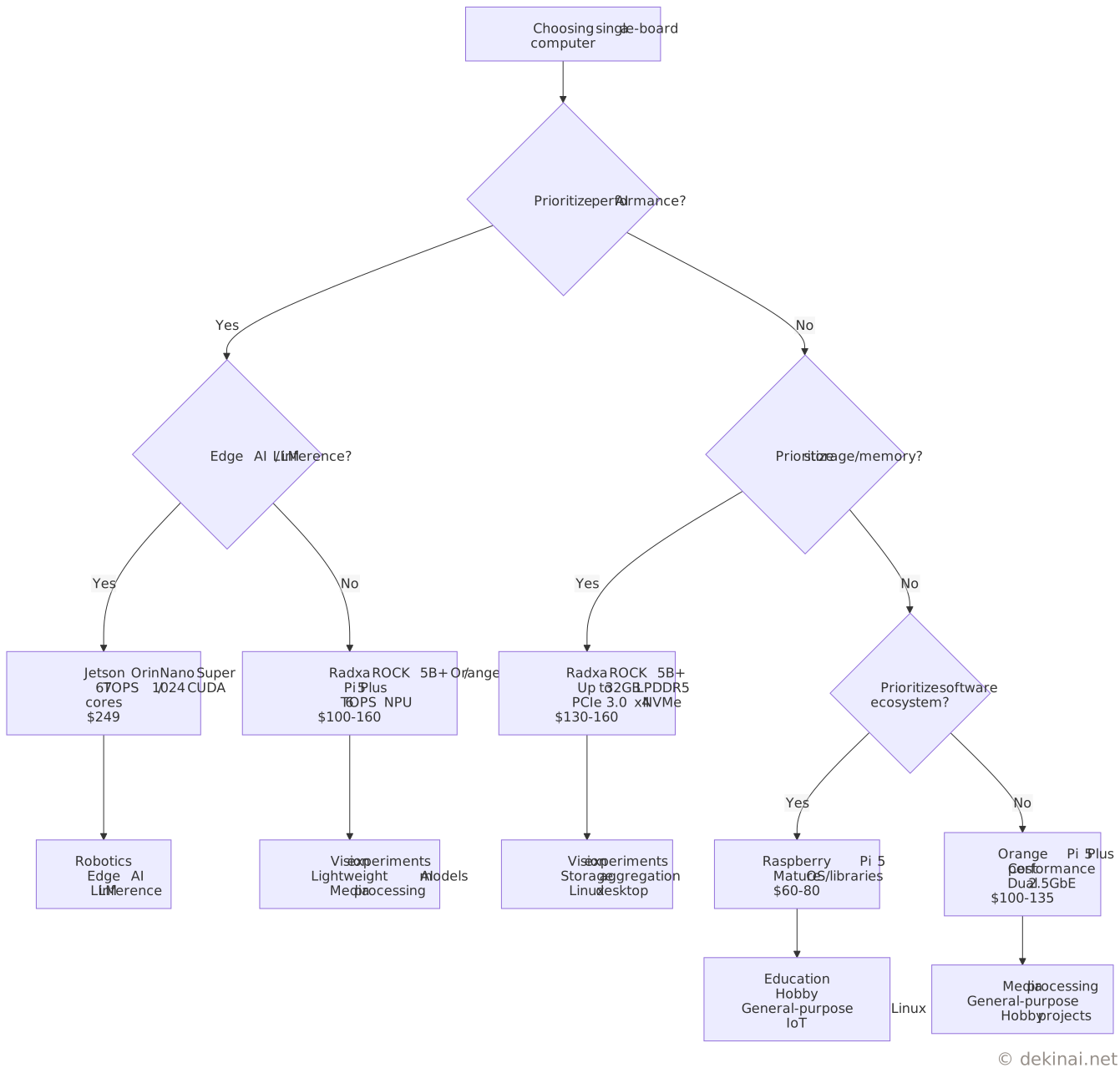
Spec Comparison Flowchart (in order of performance)
AI Performance Comparison (in order of performance: left → right, low → high)
CPU Performance Comparison (in order of performance: left → right, low → high)
Price-to-Performance Comparison (Geekbench 6 / dollar)
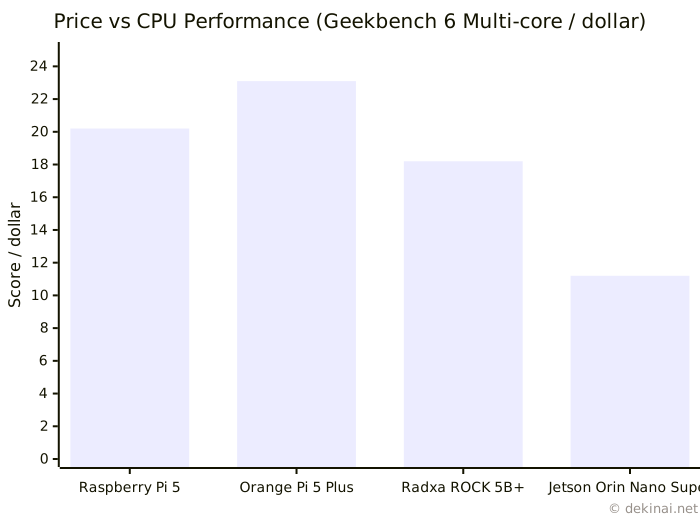
Note: Prices calculated at 8GB (Pi 5 $80), 8GB (OPi 5 Plus $135), 16GB (ROCK 5B+ $160), and 8GB (Orin Nano Super $249)
Price-to-Performance Comparison
Geekbench 6 Multi-core / Dollar
| Board | Multi-core Score | Price (8GB/16GB) | Score / Dollar |
|---|---|---|---|
| Raspberry Pi 5 | 1,615 | $80 | 20.2 |
| Orange Pi 5 Plus | 3,117 | $135 | 23.1 |
| Radxa ROCK 5B+ | 2,910 | $160 | 18.2 |
| Jetson Orin Nano Super | 2,800 (estimated) | $249 | 11.2 |
The Orange Pi 5 Plus tops the cost-performance ranking at 23.1 Score/dollar, followed by the Pi 5 at 20.2 and the ROCK 5B+ at 18.2. The Jetson Orin Nano Super comes in at less than half that, at 11.2, but this is reasonable given its 67 TOPS of AI performance.
Recommended Boards by Use Case
Edge AI / LLM Inference
The Jetson Orin Nano Super is the only real option. With 67 TOPS of AI performance, CUDA/Tensor cores, and the NVIDIA JetPack ecosystem, it can run vision transformers, LLMs, and vision-language models in real time.
- If you need 67 TOPS of AI performance and a 1024-core Ampere GPU
- If you're running edge inference for LLMs or vision transformers
- If you want to leverage the NVIDIA JetPack ecosystem and robotics development tools
- If you need LLM inference speeds 3-4x faster than the Pi 5
General-Purpose Linux Desktop / Storage Aggregation
The Radxa ROCK 5B+ is the best fit. With up to 32GB of LPDDR5 memory, PCIe 3.0 x4 NVMe (1,820-2,100 MB/s), and dual 2.5GbE, it's also appealing for having the most robust official support from Armbian.
- If you need up to 32GB of LPDDR5 memory and PCIe 3.0 x4 NVMe
- If you prioritize mainline Linux support such as Armbian
- If you need dual 2.5GbE and 8K output
- If you need 70-80% higher CPU performance and 2x the NVMe speed of the Pi 5
Cost Performance / Hobby Projects
The Orange Pi 5 Plus offers the best overall balance. With the RK3588's 8-core CPU, a 6 TOPS NPU, dual 2.5GbE, M.2 NVMe, and HDMI input, the 8GB model remains affordable at $100-135.
- If cost performance is your top priority
- If you're doing media processing or vision builds as a general-purpose SBC
- If you need dual 2.5GbE and M.2 NVMe
- If you need HDMI input functionality
Education / Hobby / Software Ecosystem
The Raspberry Pi 5 remains the strongest choice. It offers the most mature software ecosystem and community support, built-in Wi-Fi/Bluetooth, and access to the official OS (Raspberry Pi OS) along with a wealth of libraries.
- If you need the most mature software ecosystem and community support
- If you want to keep costs down for education, hobby, or general-purpose Linux use
- If you want built-in Wi-Fi/Bluetooth without additional hardware
- If you want to leverage the official OS (Raspberry Pi OS) and its many libraries
Considerations and Purchasing Advice
Jetson Orin Nano Super Considerations
- The 67 TOPS performance is enabled via a JetPack 6.2+ firmware update, so check the version at time of purchase
- The $249 DevKit is expensive and, as of 2026, can still be difficult to find in stock
- Power consumption of 7-25W is higher than other boards, so power supply design needs care
ROCK 5B+ and Orange Pi 5 Plus Considerations
- The NPU requires Rockchip's own toolchain (such as rknn-toolkit2) and is not CUDA-compatible
- Armbian and Ubuntu support is progressing but not yet as mature as the Pi 5's
- Pricing and availability fluctuate significantly as of 2026, and the 16GB/32GB models in particular can be hard to find
Raspberry Pi 5 Considerations
- It has no AI acceleration, and LLM inference relies on the CPU alone, managing only 5.80 tok/s (Llama 3.2 3B) — a level that's challenging for practical use
- Its PCIe 2.0 x1 is more than twice as slow as the ROCK 5B+'s PCIe 3.0 x4
- As of 2026, the 4GB model has risen in price to over ¥12,000, reducing its cost performance
Summary
In the 2026 SBC market, the best board clearly depends on the use case.
- Edge AI / LLM inference: The Jetson Orin Nano Super (67 TOPS, CUDA/Tensor cores) is the only real option
- General-purpose Linux desktop / storage aggregation: The Radxa ROCK 5B+ (32GB LPDDR5, PCIe 3.0 x4 NVMe) is the best fit
- Cost performance / hobby: The Orange Pi 5 Plus (RK3588, 6 TOPS NPU, $100-135) offers excellent balance
- Education / hobby / software ecosystem: The Raspberry Pi 5 (mature OS/libraries, built-in Wi-Fi/BT) remains the strongest choice
Once you've clarified your budget and use case, use the benchmark data and selection guide in this article to choose the SBC that's right for you.