Target audience: general readers who use AI occasionally.
This article keeps technical terms to a minimum and aims to help readers understand, at the level of how the systems work, "why different AIs seem to produce false information in different ways." This article is a general overview of how these systems work, based on each company's public documentation. It is not intended to rate or rank the performance of any specific service.
Have you heard talk like this?
"ChatGPT doesn't search, so its information is outdated." "Gemini mixes truth and lies together, so it's dangerous to trust." — These are phrases you often see on social media.
There's some truth to them as personal impressions, but they actually involve a bit of a misunderstanding. To cut to the conclusion:
- Every AI is designed to switch between "searching" and "not searching" depending on the situation.
- The "likely cause" of hallucinations (plausible-sounding mistakes) differs in kind depending on whether search is used or not.
Keeping these two points in mind changes how things look quite a bit. Let's go through them one at a time with diagrams.
1. What AI does before answering
Depending on the content of a question, AI switches between the following two behaviors.
- Questions that don't need external information: The AI answers using only its own memory (training data)
- Questions that need external information: The AI searches/retrieves information before answering, and answers while referring to that information
This behavior of "searching/retrieving before answering" is called RAG (Retrieval-Augmented Generation).
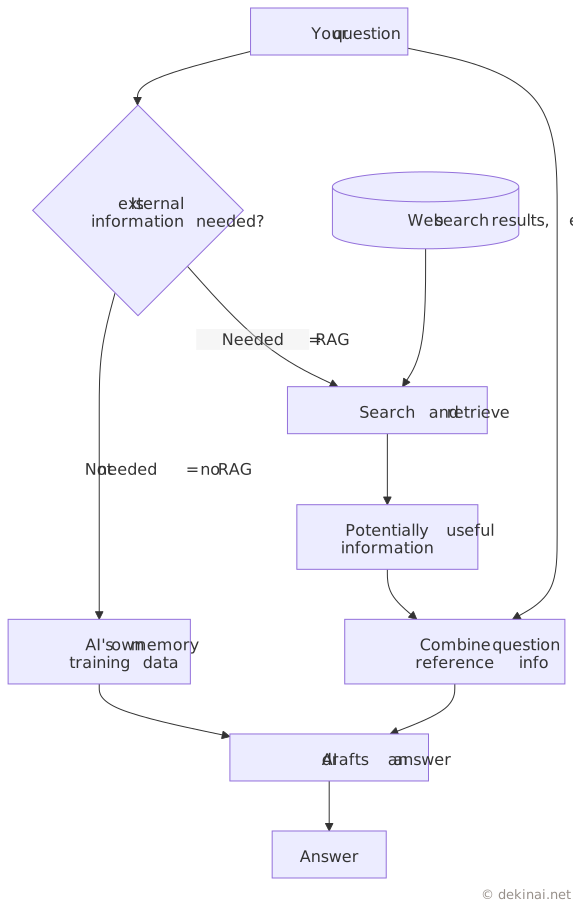
Because the AI "answers while looking at information it researched," it becomes stronger with up-to-date and specific information. On the other hand, this creates a new weakness: if the referenced information itself is wrong or off-target, that mistake gets carried straight into the answer. This is the single biggest thing to watch out for with RAG.
In the next section, we'll look at these two patterns — "with reference material" and "without" — in a bit more detail, using sequence diagrams.
2. Looking at the two behaviors as sequence diagrams
2-1. Answering using only trained knowledge
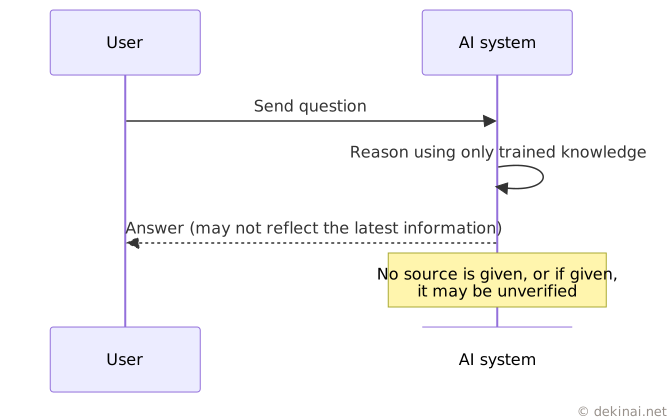
The kind of mistake likely to occur: filling in outdated or vague memory in a way that "sounds plausible."
2-2. Answering after searching (RAG / grounding)
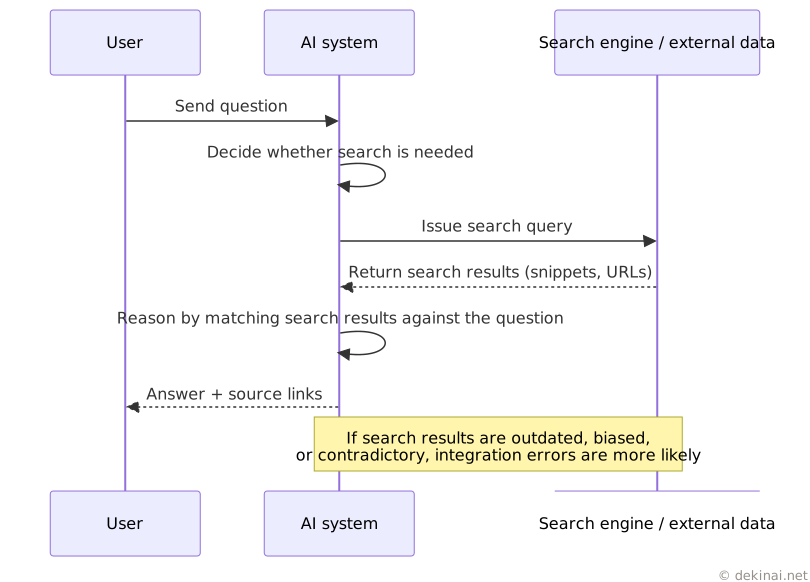
The kind of mistake likely to occur: even when the search results themselves are correct, at the summarizing/integrating stage the AI mixes information from different sources, or treats an outdated/irrelevant page as if it were correct.
Point: both approaches also share certain types of mistakes that happen regardless of the method — such as "confidently fabricating a source that doesn't actually exist" or "mixing up a different person or product with a similar name."
3. Main categories of hallucination
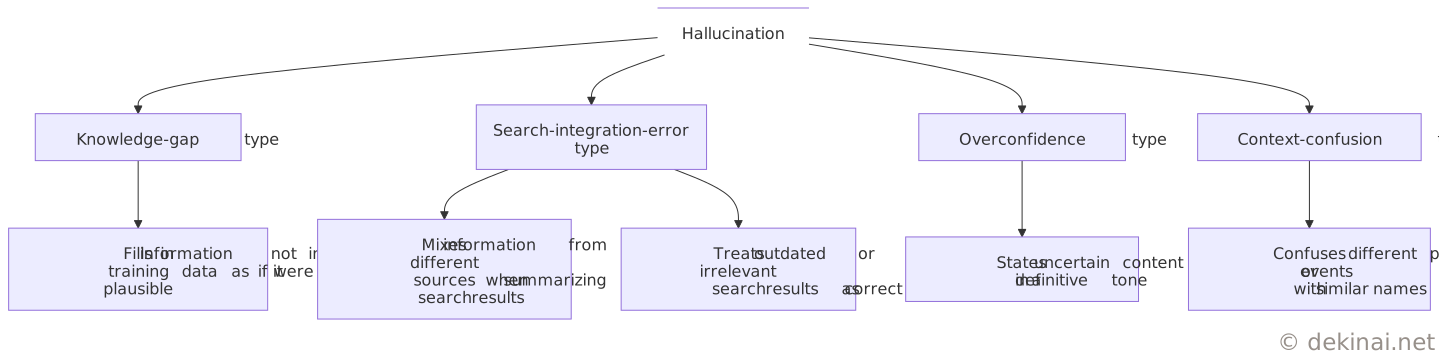
| Type | What happens | Main source | How to check |
|---|---|---|---|
| Knowledge-gap type | Fills in unknown things using familiar patterns | Mainly answers without search | Check official materials / primary sources |
| Search-integration-error type | Search results are correct, but things get skewed during summarizing/citing | When using search / grounding | Actually open the source links and cross-check |
| Overconfidence type | States uncertain content in a definitive tone | Occurs regardless of search use | Be suspicious of absolute wording like "definitely" or "always" |
| Context-confusion type | Confuses a different person or product with a similar name | Occurs regardless of search use | Break down proper nouns and cross-check them |
The knowledge-gap type and the search-integration-error type each tend to occur in fairly specific "situations," whereas the overconfidence type and the context-confusion type stem from the model's reasoning process itself, so they can occur regardless of whether search is used.
4. "Mechanism tendencies" of major services (based on public information)
The following organizes the differences in mechanisms that each company officially explains, and is not an evaluation of superiority or inferiority. Search functionality itself is continuously updated by each company, and actual accuracy varies depending on the model version, settings, and the content of the question.
| Service | Position of search (from public information) | Characteristics |
|---|---|---|
| ChatGPT (OpenAI) | Designed so the AI automatically decides whether to search based on the content of the question. Search can also be manually turned on/off, and is available on all plans including the free plan | When searching, it organizes key points from multiple sources and presents source links |
| Gemini (Google) | Has a "grounding" mechanism linked with Google Search, where the AI itself autonomously constructs the search query | Designed to present sources (cited URLs) as metadata |
| Claude (Anthropic) | Performs search only in environments where the web search tool is enabled, and attaches citations to the supporting text | Designed to link the cited text with the generated text, making it easy to trace which claim comes from which source |
| Copilot (Microsoft) | Grounding is performed via Bing Search, or, depending on the environment, in conjunction with organizational data within Microsoft 365 | May issue multiple search queries depending on the conversational context |
| Perplexity-type services | Services characterized by constructing answers based on search results and foregrounding the sources | Often used for comparing multiple pages or for initial research with citations |
All services share the trait of "switching between searching and not searching depending on the situation." In other words, even the same service can behave differently depending on how you phrase the question, the mode, and the settings, so blanket statements like "this AI lies" or "that AI is accurate" don't match reality.
5. Where mistakes are likely to occur, by use case
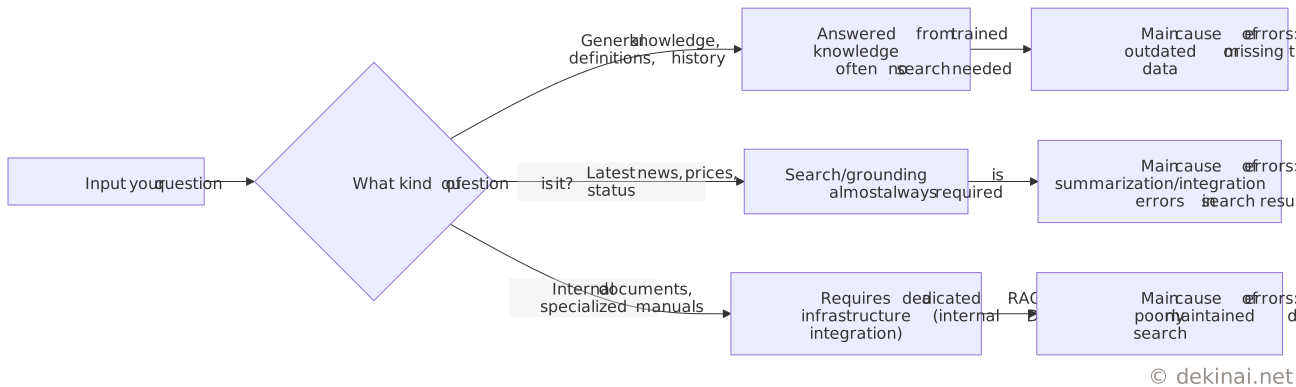
Even for the same "hallucination," the cause changes depending on the nature of the question, so rather than debating which service is superior, it's more practical to think about "which behavior suits this particular question right now."
6. How to work with this in practice (common countermeasures)
- Even when source links are attached, actually open them and check the content (because mismatches tend to occur at the summarizing stage)
- Cross-check easily-mistaken elements like numbers, proper nouns, and dates across multiple sources
- Check each time whether "search mode" is actually enabled (even within the same service, recency can vary greatly depending on the mode)
- Work from the premise that a definitive tone doesn't necessarily mean it's correct, and keep asking whether there's actually evidence behind it
- When used for important decisions, it's safer to treat AI as a means of reaching primary sources (official sites, primary materials)
7. Recap of terms
For readers who've made it this far, here's a recap of the terms that came up.
| Term | Meaning |
|---|---|
| Answering from trained knowledge | A method where the AI answers based only on data up to the point it was trained. Responses are fast, but weak on recent events |
| RAG (Retrieval-Augmented Generation) / grounding | A method where, before answering, the AI retrieves relevant information from a search engine or internal database and answers with reference to it. Recency improves, but this also creates a new weakness: the quality of the retrieved information directly determines the quality of the answer |
| Hallucination | A general term for an AI generating content that sounds plausible but doesn't match the facts. It can occur regardless of whether search is used, but the type of cause differs |
The important point is that having a search feature does not mean an AI "never lies." If search accuracy is low, it can actually produce a plausible-sounding mistake complete with a source URL attached. This is a weakness unique to search-enabled answers that doesn't exist in answers without search.
8. Summary
- Answers without search carry the risk of "outdated knowledge," while answers with search (RAG/grounding) carry the risk of "integration errors in search results" — these are different kinds of risk
- Which is better can't be said in general terms; the optimal approach changes depending on the combination of question type and mode
- Every company is continuously working to improve the accuracy of search integration and citation display, and the mechanisms are updated daily
- The most effective basic habits for users are: "check the sources," "be aware of the mode," and "verify important decisions against primary sources"
This material is a general overview of how these systems work, based on each company's public documentation and technical explanations, and is not intended to evaluate the performance of any specific service, claim superiority or inferiority, or assert any permanent characteristics. Because search feature specifications continue to be updated, please check each company's official site for the latest information.